The 1981 'Short' Board

DIY Board
The boards available in the 1981 were typically 3.90m long and weighed about 20kg. The windsurfing magazines carried articles about people who had put windsurfing rigs onto surfboards and about DIY construction of boards.
Phil Ingold and I decided to make our own and shared some of the materials. The boards were shaped from a foam block and covered with woven Kevlar and epoxy resin. The block was high density polystyrene foam and was then used in the furniture industry; the blocks were 96"x 48"x 6" so each of us started with 96"x 24"x 6". At that time, mast feet plugged into sockets about 5" deep so our boards had to have this depth. The basic shaping was done with a hot wire cutter made from the top string of a guitar and a battery charger, final shaping was with sandpaper. The Kevlar weave was coarse so an epoxy/microballoon mixture was applied to the planing area to provide a smooth surface.
This image was taken before the front foot straps were attached. The board is 3.05m long and weighs about 10kg; the hull bottom is plain without concaves or similar features and the rails are sharp edged for the last third of the length. The single fin was also home made because all production fins were tiny at that time. There is a mast track, mostly because there was little agreement about the best position of the mast foot
The board planes well and can be gybed but, with hindsight, there is too much taper towards the rear and insufficient planing area. Spin out is not a problem.
Sailing the board was difficult with the very long booms of the early 1980s rigs. Most sails at the time were partly battened, sometimes with one full length batten near the head. As sails have improved, the board has become easier to use but the hull design means that it will never have the speed of later designs.
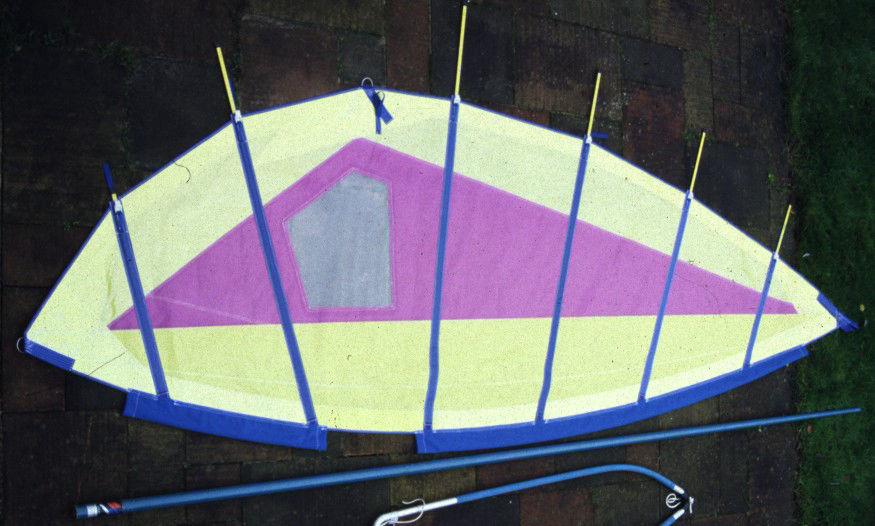
DIY Sail
Some fully battened sails came on the market in the mid 80s at a price. One entrepreneur produced a kit of pre-cut panels for home assembly. This became project two in DIY windsurfing, mainly for my wife. The purple and yellow areas were sewn together from the pre-cut panels and the blue sleeves stitched on for the battens and mast.
A lot of tension was needed at the downhaul to bend the mast enough to get a suitable sail shape. Without the tension, the camber was too great for the battens to rotate. The sail was about 5 sq m and just about usable. The shape and tension resulted in a stiff sail with tight leech so gusty winds were a problem.
The success of the sail can be judged by its current hardly worn state still in its bag in the loft. Sadly, it was never a success with the DIY board.